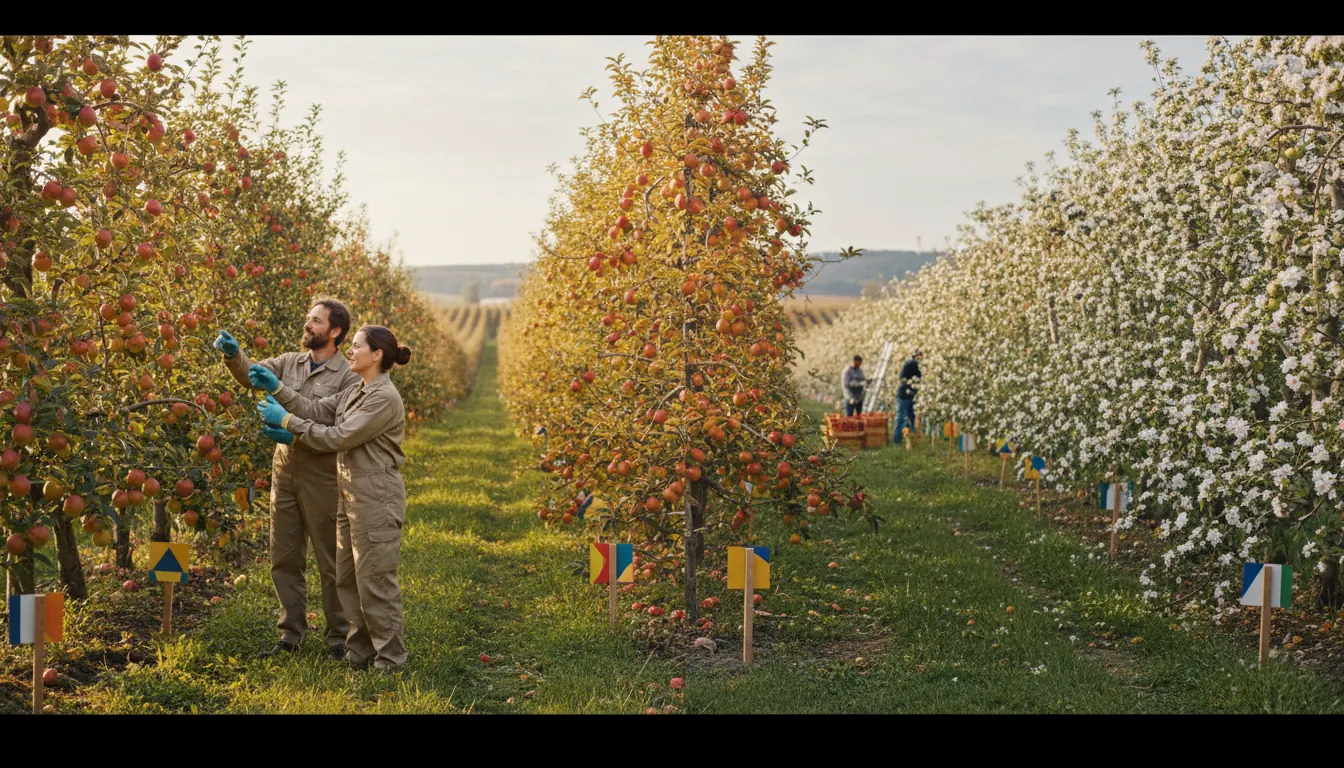
Decision Making Under Uncertainty in Apple Variety Development
Apple breeders face profound uncertainty at every stage of variety development, from initial genetic crosses to final commercial release decisions. Unlike many agricultural processes with predictable timelines, breeding new apple varieties requires committing resources to selections that won't bear fruit for years, making decisions with incomplete information about disease pressure, climate shifts, and market preferences. Understanding how successful breeding programs navigate this uncertainty reveals principles applicable across agricultural research and development.
Sources of Uncertainty in Breeding Programs
Breeding programs encounter uncertainty from multiple directions simultaneously. Genetic outcomes from crosses remain unpredictable despite advances in marker-assisted selection, as complex traits like flavor and texture involve hundreds of genes interacting in ways researchers still don't fully understand. Environmental variability adds another layer—a seedling thriving in one test location may struggle in another microclimate just miles away.
- Genetic recombination creates unique combinations that can't be predicted from parent traits alone
- Disease pressure varies annually, making resistance evaluation require multi-year testing
- Consumer preferences shift over decades-long breeding timelines, changing target characteristics
- Climate patterns evolve, requiring varieties adapted to conditions that may not yet exist
- Market dynamics transform between selection and commercialization, affecting variety success

Risk Management Strategies
Successful breeding programs employ several strategies to manage inherent uncertainty while maintaining progress toward useful varieties.
| Strategy | Application | Benefit |
|---|---|---|
| Population diversity | Maintain large seedling populations | Increases probability of exceptional individuals |
| Multi-site testing | Evaluate across diverse environments | Reveals adaptability and consistency |
| Staged selection | Progressive elimination over years | Balances resources with information gain |
| Grower feedback | Real-world commercial trials | Validates performance beyond research settings |
"The best breeding decisions balance scientific data with practical experience, acknowledging that we're managing probabilities rather than certainties in variety development."
Long-Term Outcome Focus
Effective breeding programs maintain focus on long-term outcomes despite short-term pressures. Rather than rushing promising selections to market, patient evaluation across multiple seasons and locations provides the data needed for confident release decisions. This approach, exemplified by organizations like the Midwest Apple Improvement Association, produces varieties with demonstrated reliability rather than uncertain performance. The commitment to thorough testing under uncertainty ultimately creates more valuable outcomes for growers and consumers.